
Agrivoltaics and Thermal Storage as a Path to Sustainable and Resilient Farming DBU Funding Programme — Renewable Energy & Efficiency 2026-2028


Project title: Demonstration of Vertical Agrivoltaic System Integrated with Thermal Storage
Project acronym: AGRIVOLT CZ
Application code: AZ41000
Grant: Deutsche Bundesstiftung Umwelt (DBU)
Call: Funding theme 6: Renewable energy, energy saving and efficiency
Priority: Sustainable agriculture and renewable energy
Specific objective: Demonstration of innovative agrivoltaic systems with thermal energy storage to support renewable energy use, energy efficiency, and climate adaptation in Central European agriculture
Amount of financial contribution: EUR 149,822
Project duration: 02/2026 – 01/2028
Project description
Intensive agricultural production and growing climate variability are placing increasing pressure on farmland, energy systems, and food security. In response, agrivoltaics, the combined use of land for both solar energy generation and crop cultivation, has emerged as a promising approach to addressing these challenges simultaneously. By shading crops from extreme heat, reducing water evaporation, and generating renewable electricity, agrivoltaic systems offer measurable benefits for both farmers and the environment.
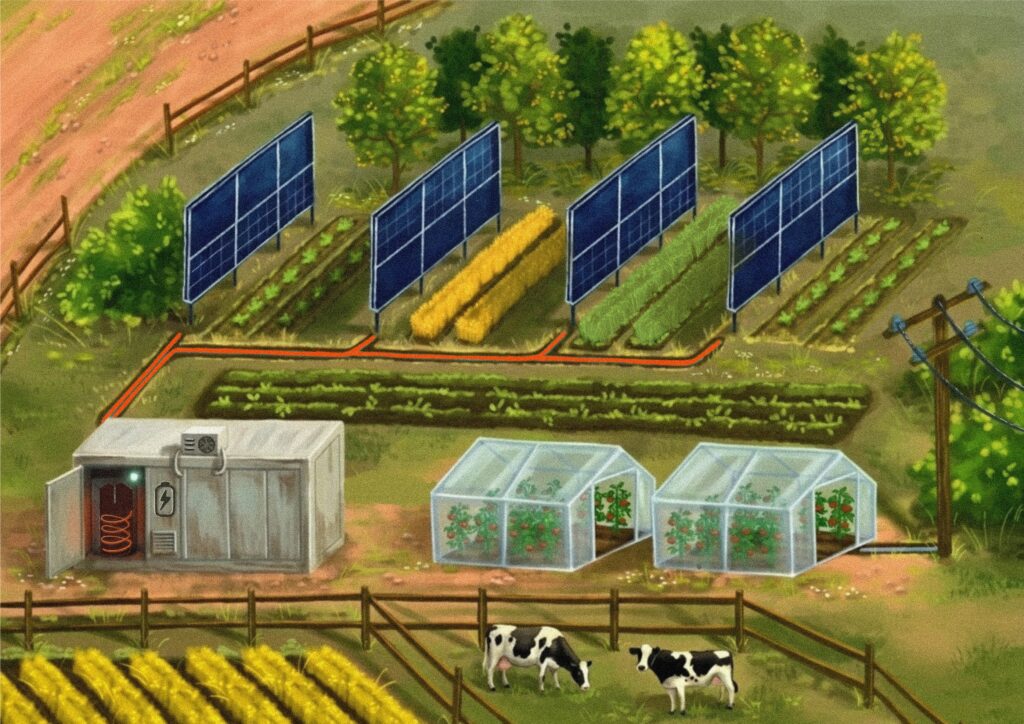
This project responds to the shared need for practical, field-tested demonstrations of agrivoltaic technology under Central European conditions. Its main objective is to design, install, and validate a vertical agrivoltaic system coupled with a phase-change material (PCM) thermal battery and a year-round greenhouse at the Czech Agrifood Research Center (CARC) in Prague-Ruzyně. The system combines four vertical bifacial photovoltaic rows (15 kWp) with an experimental crop plot growing oats and barley in rotation, together with two identical greenhouses: the first equipped with a PCM thermal battery (~69 kWh of usable storage), and the second serving as a grid-heated reference unit.
The project evaluates the agronomic, energy, environmental, and economic performance of this integrated system. Key indicators include crop yields and grain quality, in-canopy photosynthetically active radiation (PAR), soil and air microclimate, land-use efficiency (LER), thermal battery performance, greenhouse self-consumption rate, and carbon footprint. The collected data will also be used to calibrate an agrivoltaic simulation model in order to generalise the findings for the wider Central European region.
Results and lessons learned will be actively shared with farmers, agronomists, agricultural engineers, students, policymakers, and research institutions in both the Czech Republic and Germany, through field demonstration days, student excursions, expert publications, infographics, and a dedicated project website and social media presence.